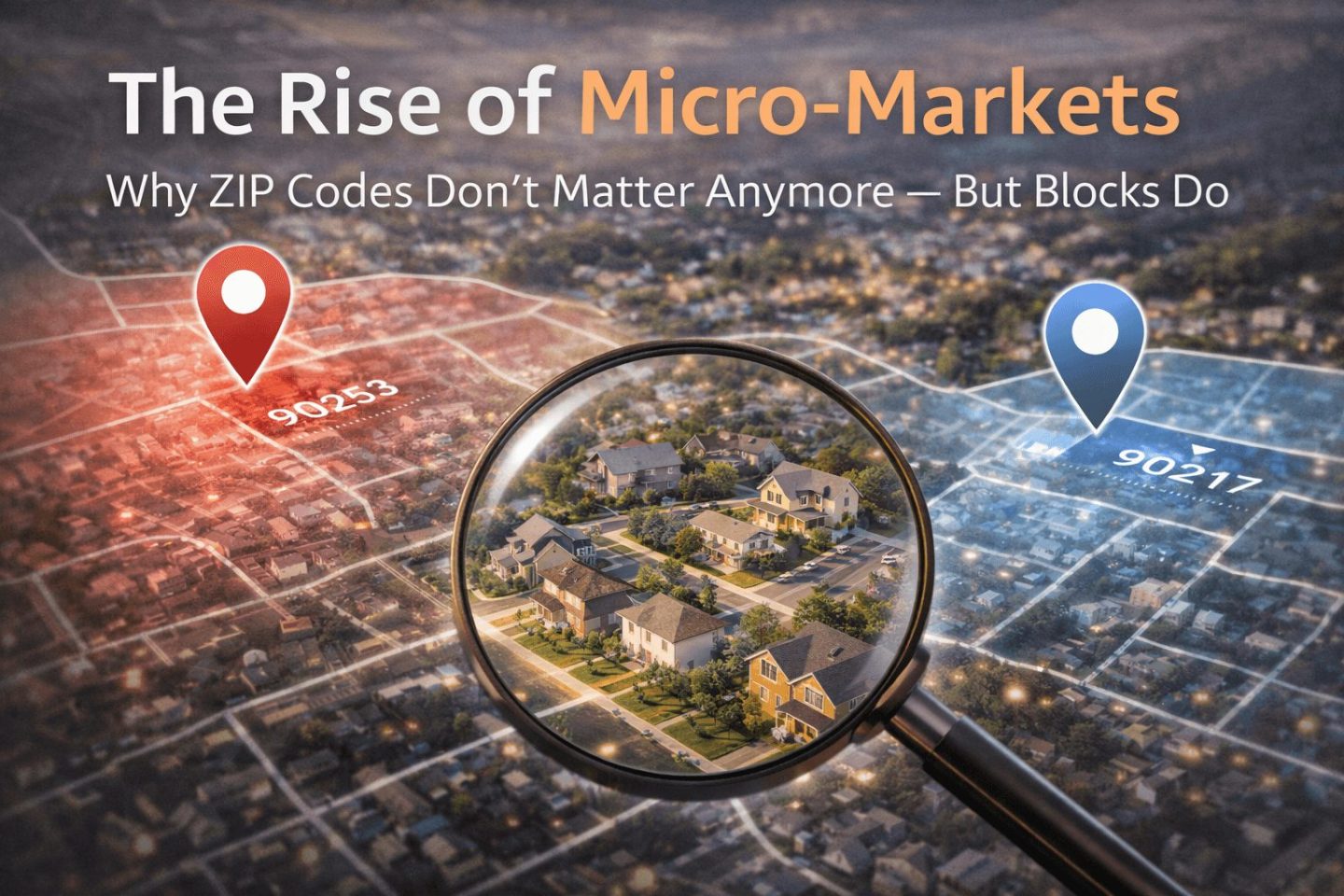
For more than a century, real estate agents, brokers have leaned heavily on ZIP codes to explain value. Pricing conversations, market reports, buyer searches, and appraisals were built around neatly defined geographic boundaries. If a home fell inside a certain ZIP code, a series of or even a lack-there-of expectations often followed, almost automatically. Buyers knew what they were getting. Sellers knew what they could ask or expect. Agents felt confident framing the conversation. That certainty has begun to fade a bit.
Across the country, the real estate market is fragmenting into smaller and smaller segments. Two homes, just a few streets apart can perform very differently. One block could sell almost instantly, while the next one struggles mightily. Pricing logic that once worked at a ZIP-code level now feels outdated, sometimes even misleading.
If you haven’t heard about it yet, let this be your “welcome to the era of micro-markets” moment, where city and surburban blocks will matter more than (the more traditional) ZIP codes, and local nuance is becoming the most valuable currency in real estate.
How We Got Here: Why ZIP Codes Used to Work
ZIP codes became a convenient shorthand for value because markets once moved in broader, more uniform patterns. Development happened in waves. Housing stock was relatively consistent within neighborhoods. Buyers had fewer data sources and relied on the general location to assess desirability. A ZIP code could reasonably capture:
- School districts
- Commute patterns
- Price ranges
- Housing styles
- Neighborhood reputation
It was imperfect, but it worked well enough. Technology also reinforced this thinking. Early MLS systems, portals, and market reports were structured around large geographic buckets. ZIP codes were easy to visualize, easy to explain, and easy to scale across markets but, convenience came at the cost of precision, and today’s market no longer behaves in ways that reward broad assumptions.
What Changed: The Forces Driving Micro-Markets

The rise of micro-markets is not random. It is the result of multiple forces colliding at once.
1. Buyers are more selective than ever
Today’s buyers arrive informed, cautious, and highly specific. They are not just asking which ZIP code a home is in. They want to know:
- What the street feels like at night
- How traffic flows at rush hour
- Which blocks the flood
- Where noise travels
- How close neighbors really are
- Which side of the street gets better light
Two properties with the same ZIP code suddenly feel worlds apart.
2. Remote and hybrid work changed location priorities
When daily commuting mattered less, hyper-local quality of life mattered more. Buyers began prioritizing walkability, quiet streets, proximity to parks, and neighborhood character over traditional commute-based location logic. This pushed value differences down to the block level.
3. Housing stock is aging unevenly
In many areas, renovations are happening one property at a time, not in sweeping developments. One block may have several recently updated homes, while the next has not seen meaningful investment in decades. ZIP codes do not capture renovation density. Blocks do.
4. Investors are targeting with surgical precision
Investors no longer buy entire ZIP codes. They buy specific streets where numbers work. They track rent performance, tenant behavior, turnover, and maintenance costs at a granular level. Their activity reshapes micro-markets faster than broad trends ever could.
5. Data transparency exposes inconsistencies
Consumers now see everything. Sale histories, price reductions, time on market, and neighborhood comparisons are public. Patterns emerge quickly, and buyers notice when one block behaves differently from another.
What a Micro-Market Actually Is
A micro-market is not just a buzzword. It is a measurable, behavioral reality. A micro-market may be defined by:
- A handful of streets
- One subdivision
- A single block
- A school boundary shift
- Proximity to a park or commercial corridor
- Zoning differences
- Floodplain lines
- Noise or traffic patterns
These boundaries rarely align with ZIP codes, and they often defy traditional neighborhood names. In a micro-market, pricing, demand, and buyer behavior are driven by factors that are invisible at higher levels of analysis.
Why Two Homes in the Same ZIP Code Can Have Totally Different Outcomes
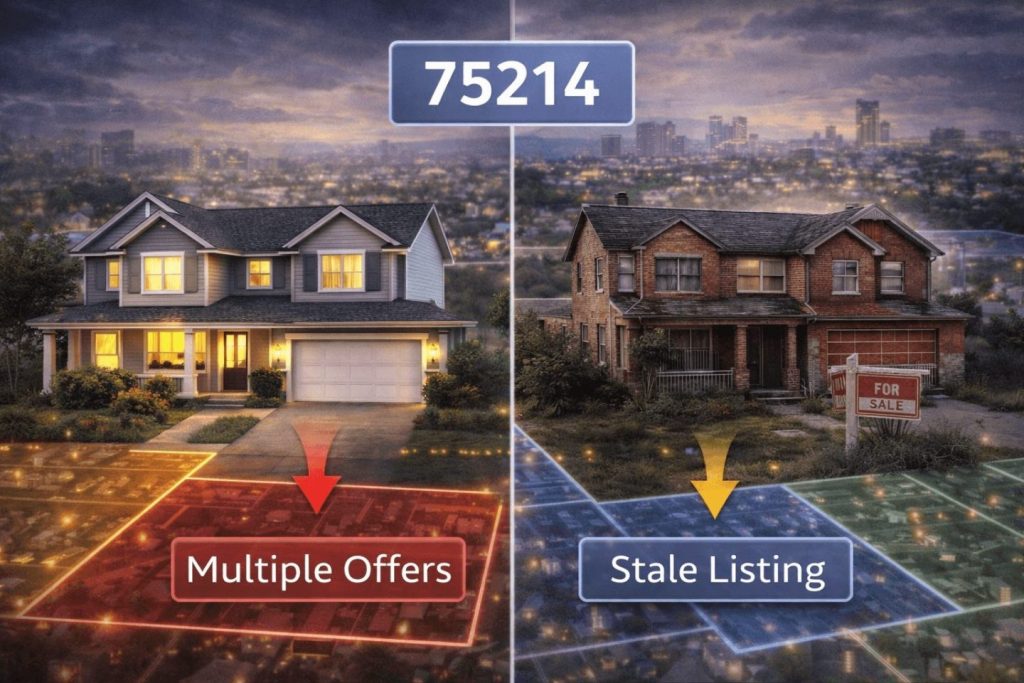
Agents see this every day. One listing attracts multiple offers in a week. Another, less than a quarter mile away, sits for months. Same ZIP code. Same school district. Similar square footage. Completely different result. The difference usually comes down to:
- Street layout
- Lot orientation
- Parking access
- Nearby commercial spillover
- Traffic patterns
- Adjacent zoning
- Nearby rental concentration
- Short-term rental presence
- Block-by-block reputation
ZIP-code averages smooth these differences away. Micro-market analysis exposes them.
Why Buyers Are Shopping at the Block Level
Buyers are not just buying homes anymore. They are buying predictability. After years of market volatility, buyers want certainty. They want to know not only what a home is worth today, but how it will behave over time. That leads them to asking block-level questions:
- Do homes here resell easily?
- Do prices dip faster on this street?
- How stable are neighbors?
- Are rentals increasing or decreasing?
- Does traffic change seasonally?
This mindset rewards agents who understand micro-markets deeply and punishes those who rely on broad comparisons.
How Micro-Markets Are Changing Pricing Conversations
Pricing a home using ZIP-code comps is increasingly risky. When agents price based on large areas, they often miss:
- Block-specific premiums
- Block-specific penalties
- Buyer perception shifts
- Hyper-local demand pockets
This leads to overpricing or underpricing, both of which cost sellers time and money. Savvy agents now frame pricing conversations around where the home sits within the micro-market, not just within the ZIP code.
What This Means for Appraisers
Appraisers are feeling the micro-market shift intensely. Valuations that rely too heavily on broad comps are being challenged more often. Lenders and buyers ask why a home on one block should be valued the same as another when buyer behavior clearly differs. Strong appraisals now require:
- Tighter comp selection
- Clear justification for block-level adjustments
- Neighborhood boundary explanations
- Commentary on local influences
- Acknowledgment of demand differences
Micro-market awareness strengthens appraisal credibility.
How Agents Can Win in a Micro-Market World

The rise of micro-markets creates an opportunity for real estate professionals willing to go deeper.
1. Become a block expert, not just a neighborhood expert
Know which streets perform better and why. Track patterns manually if needed. This knowledge cannot be scraped easily, which makes it valuable.
2. Adjust marketing language
Instead of selling a ZIP code, sell the block. Highlight why that specific location works, not just where it is.
3. Educate sellers early
Many sellers still think ZIP codes determine value. Agents who explain micro-markets early build trust and avoid difficult price corrections later.
4. Create hyper-local content
Market updates that focus on micro-areas stand out. They also perform better online because they match how buyers search.
5. Guide buyers with confidence
When buyers feel overwhelmed, block-level insight becomes a differentiator. It turns agents into advisors, not just door openers.
Why ZIP Codes Are Becoming a Starting Point, Not a Conclusion
ZIP codes are not useless. They are just no longer sufficient. They help narrow search areas, frame macro trends, and organize data. But decisions are increasingly made one layer deeper. In today’s real estate market:
- ZIP codes explain context
- Micro-markets explain outcomes
Professionals who stop at the ZIP-code level miss the story.
The Long-Term Impact on Real Estate
As micro-markets continue to dominate, the industry will see several long-term shifts:
- More localized pricing strategies
- Increased demand for hyper-local expertise
- Less reliance on national averages
- More nuanced appraisals
- A greater separation between good and average agents
Technology may provide more data, but interpretation will matter more than ever.
The Bottom Line
The real estate market has not become unpredictable. It has become more precise. ZIP codes once helped us make sense of value at scale. Now they often hide the truth. Buyers, sellers, and investors are responding by zooming in, not out. In this new landscape, blocks tell the real story.
The agents, brokers, and appraisers who understand this shift will not just survive the changing market; they will define it. Because in a world of micro-markets, success belongs to those who know exactly where value begins and where it stops.
